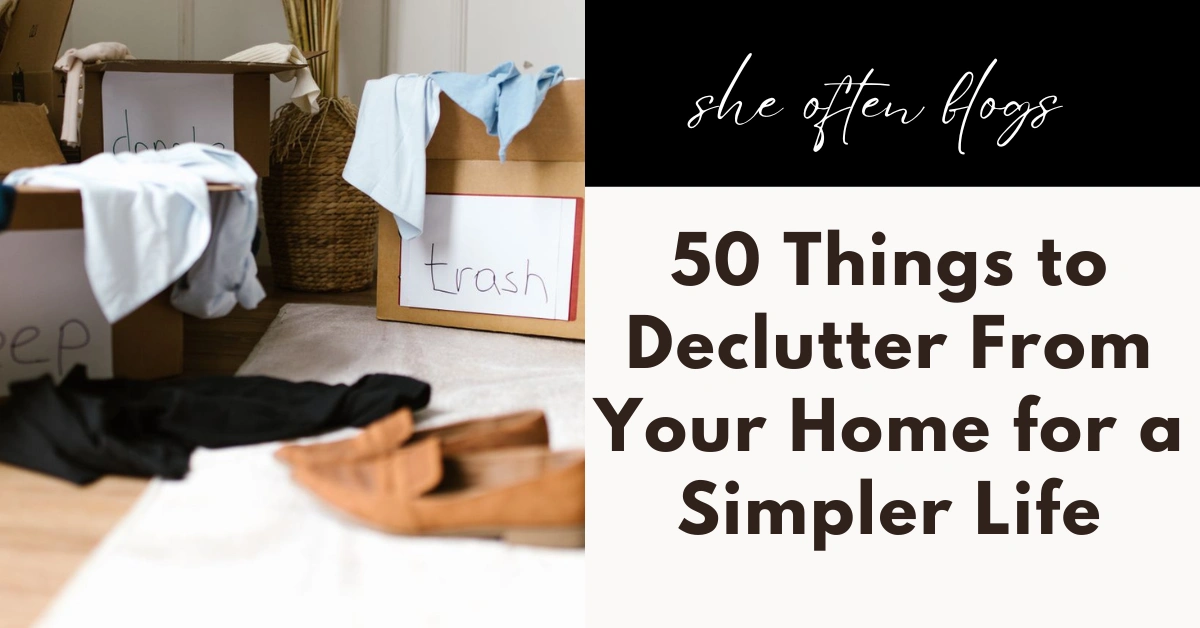
Does your home ever feel cluttered even though you regularly tidy it?
Sometimes the problem isn’t that you’re disorganized. You may simply have too many things.
Clutter has a way of quietly accumulating. A few extra mugs in the kitchen, clothes you haven’t worn in years, old paperwork, half-used products, and random items sitting in drawers can eventually make your home feel overwhelming.
This is where decluttering can make a difference.
Decluttering doesn’t mean throwing away everything you own or turning your home into an empty, minimalist space. It’s about taking a closer look at what you own and deciding what still deserves your time, space, and attention.
If you’re working toward a simpler life, you don’t have to declutter your entire house in one weekend. Start with a drawer, a shelf, or one category at a time.
To help you get started, here are 50 things to declutter from your home.
Why Decluttering Can Help You Live a Simpler Life
Before getting into the list, it’s worth remembering that decluttering isn’t just about having a tidy home.
When you have fewer unnecessary possessions, you may find that:
- Cleaning becomes easier.
- Organizing takes less time.
- You spend less time looking for things.
- Your home feels less visually overwhelming.
- You become more aware of what you actually use.
- You’re less tempted to buy duplicates.
- You have more space for the things you genuinely enjoy.
- You become more intentional about future purchases.
Decluttering can also change your relationship with your belongings.
Instead of asking, “Where can I store this?”, you can start asking:
“Do I actually need to keep this?”
That small shift can make a big difference.
50 Things to Declutter From Your Home
You don’t need to tackle all 50 at once.
Choose one category that feels manageable and start there.
Clothing and Accessories
Your closet is often one of the easiest places to begin because most of us own things we rarely wear.
1. Clothes That Don’t Fit
If something hasn’t fit you for a long time, ask yourself whether keeping it is actually helpful.
You don’t need to get rid of clothes simply because your size has changed, but if an item has been sitting untouched for years, it may be worth reconsidering.
Keep the clothes that fit your current life rather than building a wardrobe around a future version of yourself.
2. Clothes You Never Wear
We all have those pieces that look great on the hanger but somehow never make it into an outfit.
If you repeatedly skip an item when getting dressed, ask yourself why.
Maybe it’s uncomfortable, difficult to style, or simply no longer your taste.
3. Uncomfortable Shoes
Shoes that hurt your feet every time you wear them are rarely worth keeping just because they’re attractive.
If you consistently choose other shoes instead, it’s probably time to let them go.
4. Damaged Clothing You Never Repair
Do you have a pile of clothes waiting to be repaired?
Give yourself a realistic deadline.
If you haven’t repaired something in months, consider whether you’re actually going to do it.
5. Duplicate Accessories
Multiple scarves, belts, handbags, hats, or similar accessories can quickly take over your closet.
Keep the ones you genuinely use and enjoy.
6. Clothes You Keep “Just in Case”
“Just in case” is one of the most common reasons people keep things they don’t use.
Ask yourself how likely that situation actually is.
If you haven’t needed the item in years, you may be holding onto it out of fear rather than necessity.
7. Old Handbags and Purses
Look through your bags and ask yourself how many you actually use.
You may discover that you consistently reach for the same one or two.
8. Accessories You Never Wear
Jewelry, hair accessories, sunglasses, watches, and other small accessories can accumulate easily.
If you don’t wear them, they’re taking up space without adding value to your life.
Kitchen Items to Declutter
The kitchen can become a clutter hotspot because there are so many gadgets, containers, dishes, and appliances available to buy.
9. Duplicate Utensils
Do you really need five spatulas, several vegetable peelers, or multiple can openers?
Keep the ones you actually use.
10. Excess Mugs
Mugs are surprisingly easy to collect.
You may have mugs from vacations, gifts, events, or old workplaces.
Keep the ones you love and regularly use.
11. Unused Kitchen Appliances
Think about appliances sitting in your cabinets or on countertops.
When was the last time you used them?
If an appliance is taking up valuable space and rarely gets used, consider whether you can live without it.
12. Takeout Containers
Plastic containers can multiply quickly.
Keep a reasonable number of useful containers and recycle or dispose of damaged or excessive ones according to your local guidelines.
13. Chipped or Cracked Dishes
If a plate, bowl, or mug is damaged and you don’t use it anymore, it may be time to let it go.
14. Expired Food
Check your pantry, refrigerator, and freezer.
Look for expired food, ingredients you no longer use, and items you bought for one recipe years ago.
15. Kitchen Gadgets You Never Use
That one-purpose gadget may have looked useful when you bought it.
But if it’s been sitting in a drawer untouched, ask yourself whether it’s earning its space.
16. Excess Water Bottles
Many households have a collection of reusable water bottles.
Keep the ones you actually use and let go of damaged or unnecessary duplicates.
Bathroom Items to Declutter
Bathrooms often contain products we forgot we even owned.
17. Expired Skincare Products
Check expiration dates and product labels where applicable.
Dispose of products according to the manufacturer’s instructions.
18. Old Makeup
Makeup doesn’t last forever.
Go through products you haven’t used in a long time and follow the manufacturer’s guidance for when they should be discarded.
19. Empty Containers
Do you have empty shampoo bottles, skincare jars, or toiletry containers sitting around?
If you’re not actually going to reuse them, there’s no reason to keep them.
20. Toiletries You Don’t Use
Maybe you bought a product because it was popular, but you didn’t like it.
If you’re never going to use it, keeping it doesn’t make the product more useful.
21. Worn-Out Towels
Old, worn, or damaged towels can take up valuable storage space.
Keep enough towels for your household and needs rather than keeping an excessive supply.
22. Products You Don’t Like
Sometimes we keep products because we feel guilty about wasting money.
But keeping something you dislike doesn’t recover the money you spent.
If appropriate, consider whether someone else could use it or whether it can be disposed of responsibly.
Bedroom Items to Declutter
Your bedroom should ideally be a place where you can relax and recharge.
Too much clutter can make that harder.
23. Old Bedding
Go through your sheets, blankets, pillowcases, and comforters.
Keep what you actually use and remove items that are damaged or no longer needed.
24. Unused Decorations
Decorations can make a room feel personal, but too many can create visual clutter.
Keep pieces that you genuinely enjoy looking at.
25. Items Under the Bed
The space underneath the bed often becomes a hiding place for things we don’t know where else to put.
Pull everything out and evaluate each item.
You may discover things you completely forgot you owned.
26. Old Magazines
If you haven’t looked at a magazine in months or years, ask yourself whether you really need to keep it.
If there’s an article or recipe you want to remember, consider saving the information digitally where appropriate.
27. Unused Candles
Candles can accumulate quickly.
If you have candles you don’t enjoy, don’t fit your preferences, or aren’t realistically going to use, consider whether they need to stay.
28. Broken Items
Look around your bedroom for things that are broken and haven’t been repaired.
Create a realistic repair deadline.
If you don’t intend to fix something, keeping it indefinitely only creates more clutter.
Living Room Items to Declutter
The living room is usually one of the most visible areas of the home.
A little decluttering here can make a noticeable difference.
29. Decorations You Don’t Love
Not every decorative item needs to stay simply because you once liked it.
Your taste changes.
Keep the pieces that make your home feel comfortable and personal.
30. Old DVDs and CDs
If you no longer use physical media and don’t have sentimental reasons to keep it, consider whether you still need the collection.
31. Unused Electronics
Look through drawers and cabinets for old devices, chargers, cables, and electronics.
Keep only what you know you need.
For electronics, batteries, and cables, follow appropriate local recycling or disposal guidelines.
32. Excess Cushions
Too many cushions can make a sofa look crowded and create extra laundry and storage.
Keep the number that makes your space comfortable.
33. Old Magazines and Newspapers
If you’re keeping stacks of old reading material with no intention of revisiting them, recycling may be a better option.
34. Items That Don’t Belong There
Walk around your living room and identify things that belong somewhere else.
You may be surprised by how much clutter disappears simply by returning items to their proper homes.
Paper and Miscellaneous Clutter
Paper clutter is easy to ignore because it often hides in drawers, folders, and boxes.
35. Old Receipts
You probably don’t need to keep every receipt indefinitely.
Keep receipts that are necessary for returns, warranties, taxes, records, or other legitimate purposes, and dispose of the rest securely.
36. Unnecessary Paperwork
Go through old documents and determine what you genuinely need to retain.
For important documents, check the appropriate retention requirements before throwing anything away.
37. Old Product Manuals
Many product manuals are available online.
If you don’t need a physical copy and can easily access the information elsewhere, consider recycling unnecessary manuals.
38. Expired Coupons
If you haven’t used a coupon before it expired, you’re unlikely to use it now.
Clear them out.
39. Broken Stationery
Old pens, dried-out markers, empty notebooks, and broken supplies can quietly fill drawers.
Test what you have and keep what works.
40. Old Calendars
Once the year is over, most calendars don’t serve much practical purpose.
If there’s sentimental information or artwork you want to save, keep those specific pages rather than the entire calendar.
Digital Clutter Counts Too
Minimalist living doesn’t stop at physical possessions.
Your digital environment can become just as overwhelming.
41. Unused Apps
Look at your phone and identify apps you haven’t opened in months.
If you don’t need them, delete them.
42. Duplicate Photos
Your camera roll may contain multiple versions of the same photo.
Delete obvious duplicates and blurry images.
43. Old Screenshots
Screenshots are useful temporarily, but they can quickly pile up.
Go through your screenshots and delete anything you no longer need.
44. Unnecessary Email Subscriptions
If you repeatedly delete emails without reading them, unsubscribe.
A cleaner inbox means fewer distractions.
45. Duplicate Digital Files
Check your computer, cloud storage, and external drives for duplicate files.
Keep the version you need and organize important documents into clearly labeled folders.
46. Old Downloads
Your downloads folder can become a digital junk drawer.
Remove files you no longer need and organize anything important.
47. Unused Online Accounts
Think about websites and services you signed up for but no longer use.
Where appropriate, close unnecessary accounts and remove your information from services you no longer need.
48. Unnecessary Notifications
Not every app needs to interrupt you.
Turn off notifications that don’t provide genuine value.
This small change can make your phone feel significantly less distracting.
The Hardest Things to Declutter
Some things are difficult to let go of because they have emotional meaning.
These require a little more thought.
49. Things You’re Keeping Out of Guilt
Maybe someone gave you a gift that you don’t like.
Maybe an item belonged to someone you love.
Maybe you spent a lot of money on something you never use.
Guilt can make decluttering difficult.
Remember that appreciating the person or memory connected to something doesn’t necessarily mean you need to keep the physical object forever.
Take your time with sentimental possessions.
There is no need to rush.
50. Things You Haven’t Used in Years
This is one of the biggest categories of clutter.
Look around your home and identify things you haven’t used in a very long time.
Ask yourself:
If I didn’t already own this, would I choose to bring it into my home today?
If the answer is no, that may tell you something.
What Should You Do With the Things You Declutter?
Decluttering doesn’t always mean throwing everything into the trash.
Once you’ve decided what you’re removing, separate items into appropriate categories.
Donate
Items that are clean, safe, and still useful may be suitable for donation.
Sell
Higher-value items in good condition may be worth selling if you have the time and energy.
Recycle
Paper, cardboard, certain electronics, and other materials may be recyclable depending on your local recycling options.
Give Away
Friends or family members may genuinely need things you no longer use.
Dispose Responsibly
Broken, expired, damaged, or hazardous items may need special disposal methods.
Always check your local guidelines for electronics, batteries, chemicals, medications, and other items that shouldn’t go into regular household trash.
A Simple Decluttering Method You Can Use
If you’re overwhelmed by the idea of decluttering, use five categories:
KEEP
Things you use, need, or genuinely value.
DONATE
Useful items you no longer need.
SELL
Items that have enough value to make selling worthwhile.
RECYCLE/DISPOSE
Items that are broken, expired, or unsuitable for donation.
MAYBE
Items you’re genuinely unsure about.
The “maybe” category is helpful because you don’t have to make every decision immediately.
Just make sure the maybe pile doesn’t become a permanent storage system.
Don’t Try to Declutter Your Entire Home in One Day
One of the biggest mistakes you can make is trying to completely transform your home overnight.
Decluttering can be physically and emotionally exhausting.
Instead, choose a manageable goal.
Try:
- One drawer today
- One shelf tomorrow
- One closet this weekend
- One room over several weeks
You don’t need to finish everything immediately.
The goal is progress, not perfection.
How to Prevent Clutter From Coming Back
Decluttering feels great, but maintaining a simpler home is even more important.
Here are a few habits that can help.
Follow the one-in, one-out rule
When you bring something new into your home, consider removing something similar.
Use a waiting period
Before buying non-essential items, wait 24 hours.
For more expensive purchases, give yourself even more time.
Keep a donation box
Whenever you find something you no longer need, place it in the box.
Do a monthly mini-declutter
Spend 15–30 minutes once a month checking one small area.
Shop your home first
Before buying something, look around to see whether you already own something that can do the job.
Don’t buy things just because they’re on sale
A discount doesn’t save money if you wouldn’t have purchased the item otherwise.
Be intentional about what enters your home
Decluttering is easier when you’re not constantly replacing the things you just removed.
Your Simple Decluttering Challenge
If you want to put this list into action, don’t try to declutter all 50 things today.
Instead, choose 10 items from this list that you can easily remove.
Put on a timer for 20 minutes.
Walk through your home and find those items.
Then decide whether each one should be:
- Donated
- Sold
- Recycled
- Given away
- Disposed of responsibly
Once you’ve finished, stop.
You don’t have to continue just because you have more time.
The purpose of this exercise isn’t to see how much you can get rid of.
It’s to practice making intentional decisions about what deserves a place in your home.
Final Thoughts
Decluttering isn’t about creating a picture-perfect minimalist home.
It’s about creating a space that supports the life you want to live.
You don’t need to own only a certain number of things. You don’t need to get rid of everything that isn’t absolutely essential. And you certainly don’t need to compare your home to someone else’s minimalist lifestyle.
Start where you are.
Choose one drawer.
Remove a few things you no longer use.
Then notice how the space feels.
Over time, those small decisions can add up.
And as you become more intentional about what you keep, you may also become more intentional about what you buy, how you spend your time, and what you allow to take up space in your life.
A simpler life doesn’t begin with having nothing. It begins with making room for what matters.
Related posts:
Minimalist living for beginners.
Easy 2-minute tasks to keep your home organized.

I am Sidra, a passionate writer and advocate for personal growth, dedicated to helping others achieve their full potential. With a focus on motivation, inspiration, productivity, and self-help, I share practical tips and insights to empower readers on their journey to a more fulfilling life. I aim to inspire positive change and foster a mindset of success.